
Tennis Elbow: Why Your Elbow Hurts (Even If You’ve Never Played Tennis)
What Is Tennis Elbow?
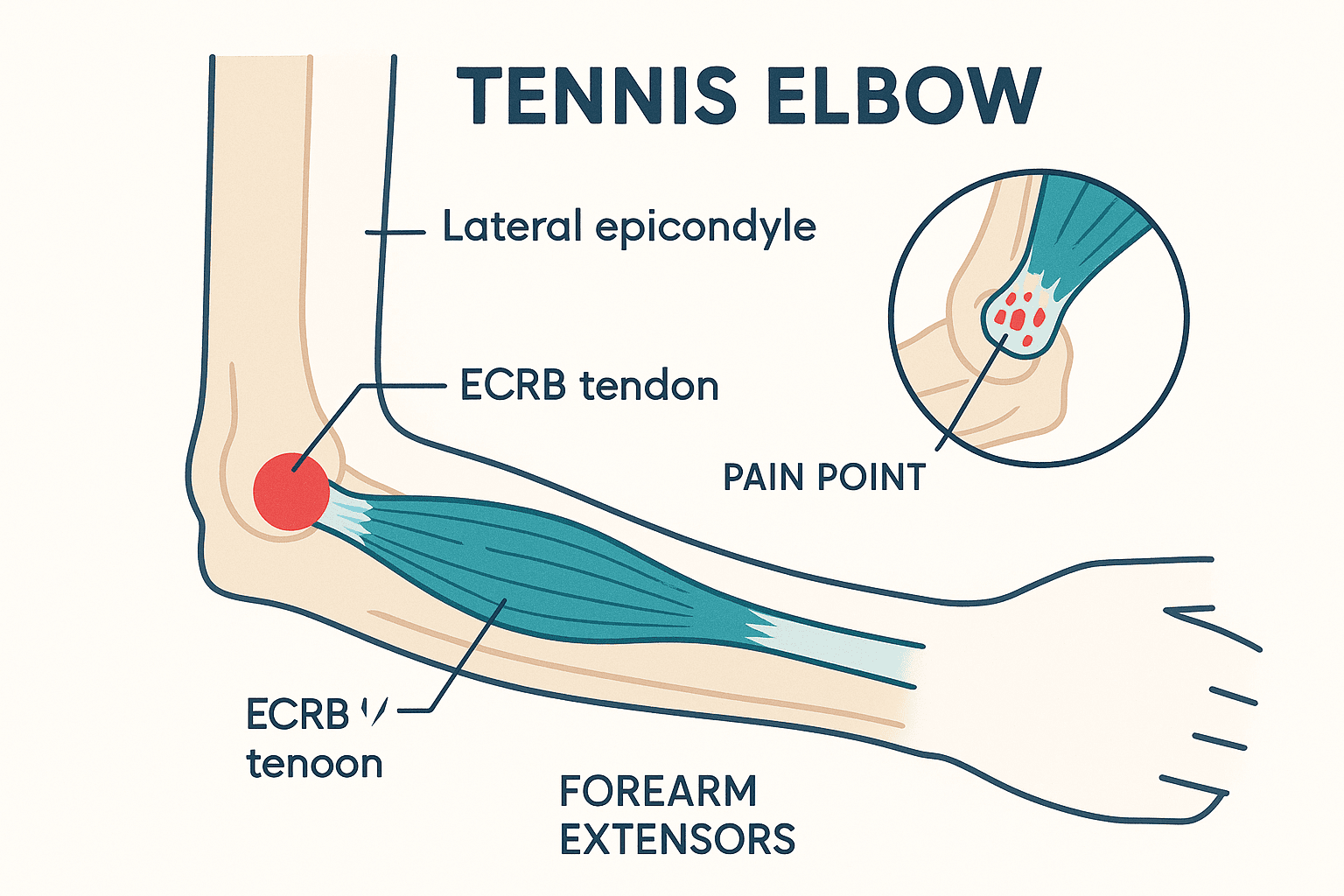
Tennis elbow is a degenerative condition of the tendons that attach the forearm extensor muscles to the bony prominence on the outer (lateral) side of the elbow — the lateral epicondyle. Despite the “-itis” in the old name, research consistently shows that the dominant pathology is not inflammation but collagen degeneration: the tendons break down from repetitive overload faster than they can repair, producing a condition better described as tendinopathy or tendinosis.
The most commonly affected tendon is the extensor carpi radialis brevis (ECRB) — one of the muscles that extends and stabilizes the wrist.
Symptoms
- Outer elbow pain — aching or burning at the lateral epicondyle
- Pain on gripping — especially with the wrist extended (lifting a bag, turning a key, shaking hands)
- Pain with resisted wrist extension — trying to extend the wrist against resistance
- Weak grip — difficulty holding objects without pain
- Pain that worsens with activity and eases with rest in early stages; may become constant in chronic cases
- Tenderness directly over the lateral epicondyle on palpation
Self-Care Strategies
Wrist Extensor Stretch
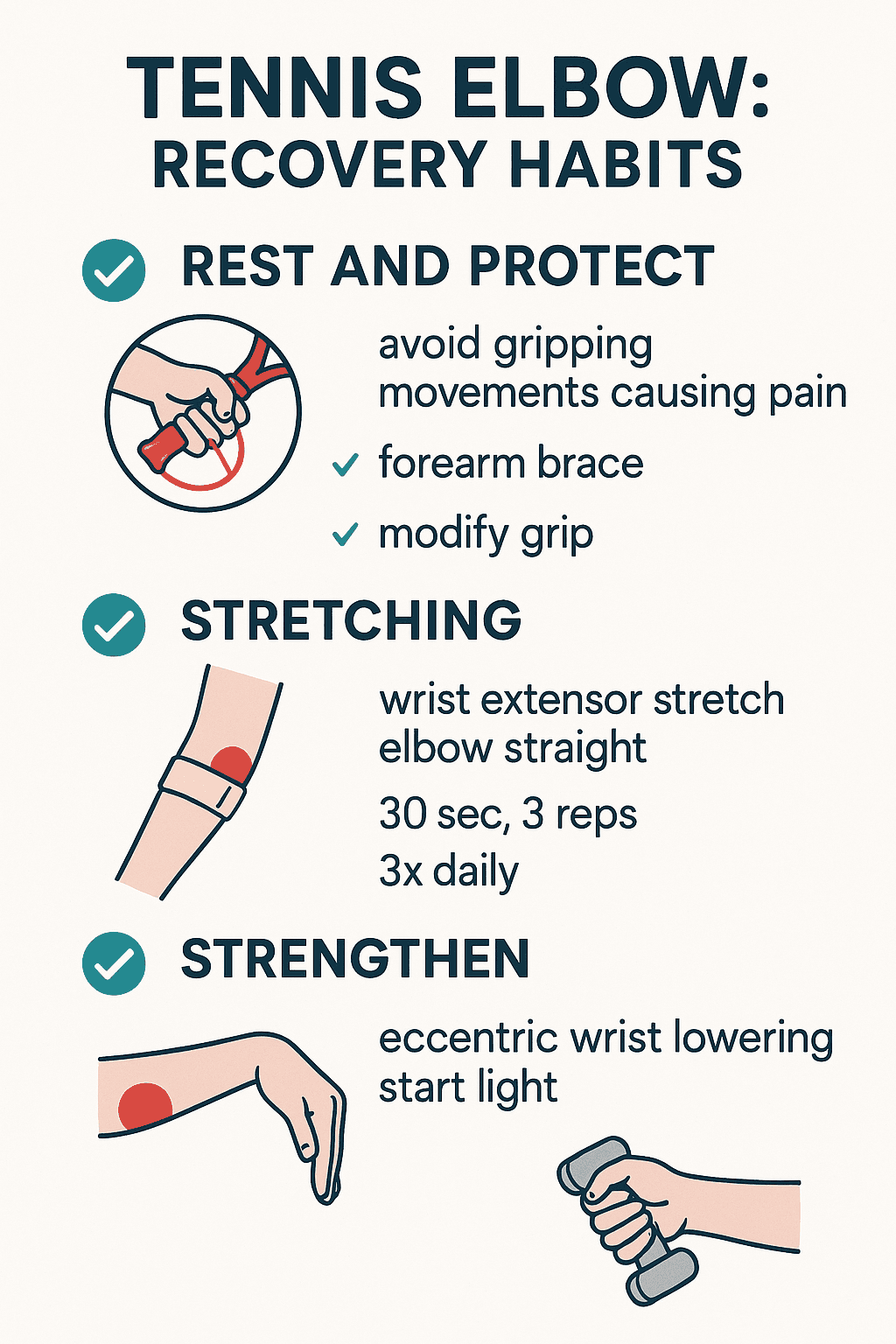
Arm straight ahead, palm down. Use the other hand to gently bend the wrist downward (into flexion), keeping the elbow straight. Feel the stretch along the outer forearm. Hold 30 seconds; repeat 3 times. Perform several times daily — it is most effective when done consistently, not just when it’s painful.
Isometric Wrist Extension (Pain-Free Loading)
Sit with your forearm resting on a table, palm facing down, wrist at the edge. Press the back of your hand upward against your other hand’s gentle resistance. Hold 30–45 seconds, 5 repetitions. This is the starting point for loading the tendon safely.
Activity Modification
- Use a forearm brace (counterforce strap) during aggravating activities — it reduces force transmitted to the tendon origin
- Reduce repetitive grip-and-extend activities while rehabilitation progresses
- Switch to a lighter mouse; improve desk ergonomics
Frequently Asked Questions
How long does tennis elbow take to heal?
With appropriate treatment, most cases resolve in 3–6 months. Without treatment, it can persist for 12–18 months or longer. The key is progressive loading — rest alone does not rebuild the tendon.
Do I need a cortisone injection?
Cortisone injections provide short-term pain relief but have been shown in multiple studies to produce worse long-term outcomes than physiotherapy alone. They are best used sparingly as a bridge to allow rehabilitation — not as a primary treatment.
Can I keep playing tennis/working during recovery?
Usually yes, with modification. Your physiotherapist will help you identify activities to reduce while keeping you functional. Complete rest is rarely necessary and slows tendon remodelling.
For patient education only. Not medical advice.