Bell’s Palsy: Understanding Facial Paralysis and the Path to Recovery
Medically reviewed by Dr. Tatsiana Vovk, ND, Licensed Naturopathic Doctor · Last reviewed May 26, 2026
What Is Bell’s Palsy?
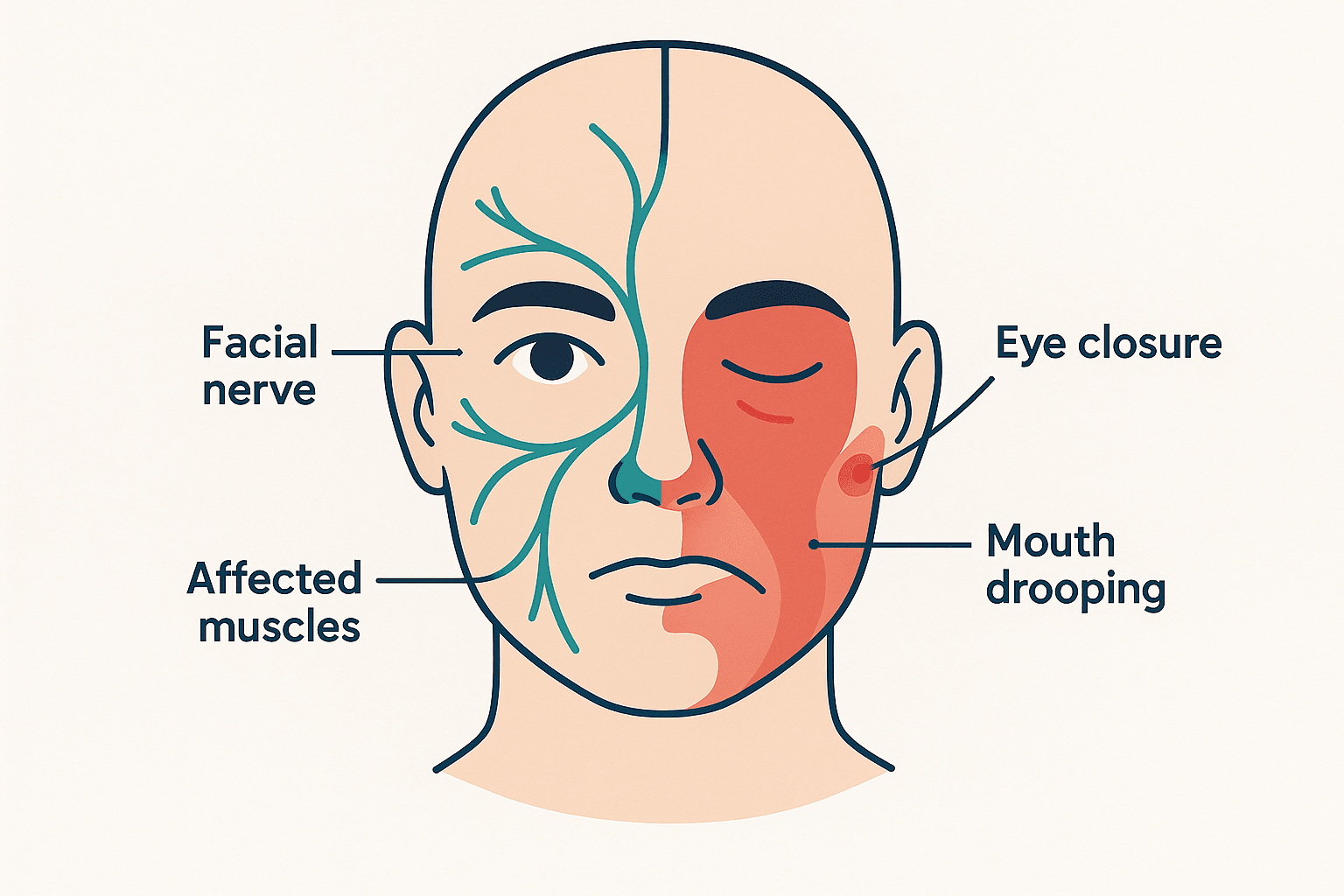
Bell’s palsy is a sudden, unilateral (one-sided) weakness or paralysis of the facial muscles, caused by inflammation and swelling of the facial nerve (cranial nerve VII) — the nerve responsible for controlling all the muscles of facial expression on one side.
It is the most common cause of unilateral facial paralysis, accounting for approximately 60–75% of all acute facial palsy cases. It affects around 20–30 people per 100,000 each year, across all age groups.
The facial nerve exits the brainstem and travels through a bony canal (the Fallopian canal) within the temporal bone before branching to reach all the muscles of one side of the face. This bony canal becomes the nerve’s vulnerability — when the nerve swells due to inflammation, the rigid canal creates pressure, cutting off blood supply and impairing nerve conduction.
Symptoms
Bell’s palsy typically develops rapidly — reaching maximum weakness within 48–72 hours:
Facial:
– Drooping of one corner of the mouth
– Inability to close the eye on the affected side (lagophthalmos) — a key concern for corneal protection
– Loss of the nasolabial fold (the crease from nose to mouth)
– Inability to raise the eyebrow or wrinkle the forehead on the affected side
– Asymmetric smile
Other symptoms (from related nerve branches):
– Hypersensitivity to sound on the affected side (hyperacusis)
– Reduced taste on the front two-thirds of the tongue
– Dryness of the eye on the affected side (reduced tear production)
– Ear pain or numbness around the ear in the prodromal phase
Prognosis and Recovery
Bell’s palsy has a favourable prognosis with early treatment:
– 70–85% of patients recover completely without treatment
– With early steroid treatment (within 72 hours), complete recovery rises to approximately 85–94%
– 10–15% of patients have incomplete recovery with some residual weakness
– ~5% have severe, permanent sequelae
Prognostic indicators for complete recovery:
– Younger age
– Incomplete (partial) paralysis at onset
– Early start of steroid treatment
– Absence of other health conditions
Recovery typically begins within 3–6 weeks and continues for up to 12 months. After 6 months with no recovery, MRI and specialist review are warranted.
Acupuncture for Bell’s Palsy
Acupuncture is the primary treatment for Bell’s palsy at Wellness Place, with a meaningful body of evidence supporting its role in improving recovery outcomes and shortening recovery time.
Mechanism of action:
– Promotes microcirculation in the facial nerve and surrounding tissue, reducing ischemia (inadequate blood supply) in the inflamed nerve
– Stimulates nerve regeneration and remyelination
– Reduces inflammation through modulation of pro-inflammatory cytokines
– Maintains muscle activity and prevents atrophy during the denervation period
What acupuncture treatment looks like:
– Local facial points targeting each branch of the facial nerve (ST4, ST5, ST6, ST7, GB2, TE17, LI20, BL2, GB14, ST2)
– Distal points to activate the nervous system and support recovery (LI4, ST36, GB34)
– Electroacupuncture (e-stim through the needles) to stimulate denervated muscles and accelerate reinnervation
Timing: The optimal time to begin acupuncture is controversial — some practitioners wait until the acute inflammatory phase (first 1–2 weeks) subsides; others begin immediately. Current evidence suggests beginning within the first 1–2 weeks produces better outcomes than delayed treatment. Your acupuncturist will assess the stage and severity of your paralysis to guide timing.
Evidence: Multiple systematic reviews and meta-analyses show that acupuncture — particularly when combined with steroid treatment — produces higher complete recovery rates and faster recovery than steroids alone. Electroacupuncture appears particularly effective.
Frequently Asked Questions
How do I know if it’s a stroke or Bell’s palsy?
In a stroke, the forehead is typically spared — the affected person can still raise the eyebrow on the affected side, because the forehead receives nerve supply from both sides of the brain. In Bell’s palsy, the entire side of the face is affected — including the forehead (inability to raise the eyebrow). This is the key clinical distinction. However, if you are uncertain, treat it as a possible stroke and seek emergency assessment immediately.
How long will recovery take?
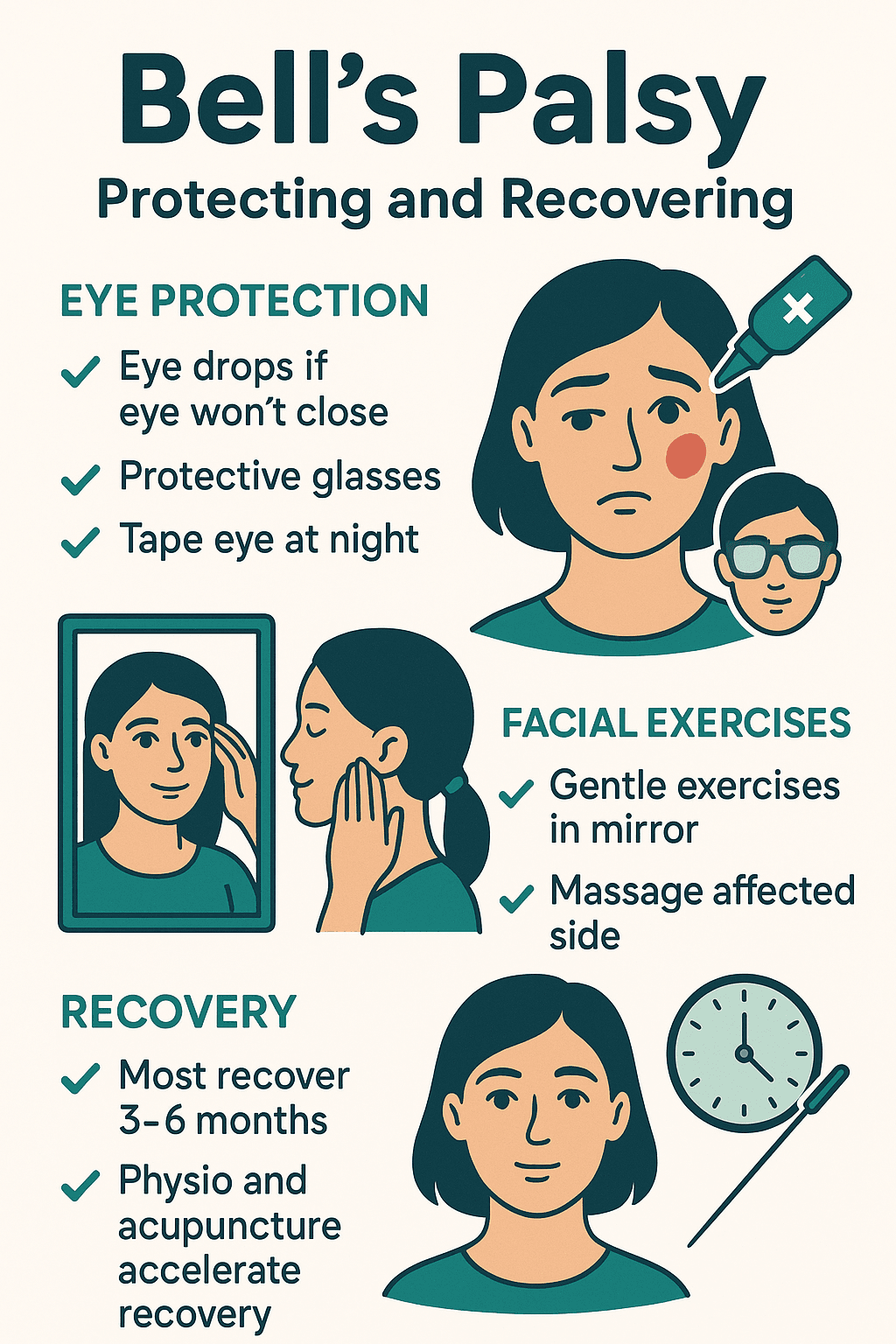
Most people begin to see improvement within 3–6 weeks. Complete recovery (if it occurs) typically happens by 3–6 months. The process continues for up to 12 months. Acupuncture and facial exercises support the recovery process throughout.
Will I fully recover?
With early steroid treatment and active rehabilitation, the majority of people with Bell’s palsy recover completely or near-completely. The subset with severe initial paralysis, older age, or delayed treatment have somewhat lower rates of complete recovery, but meaningful recovery is still common.
Can Bell’s palsy come back?
Recurrence occurs in approximately 7–12% of cases — sometimes on the same side, sometimes the other side. Recurrence should prompt investigation to rule out other causes.
For patient education only. Not medical advice.