
Neck Pain: Understanding, Treating, and Moving Beyond the Ache
Medically reviewed by Dr. Serguei Naoumov, DC, Licensed Chiropractor · Last reviewed May 26, 2026
The Architecture of Your Neck
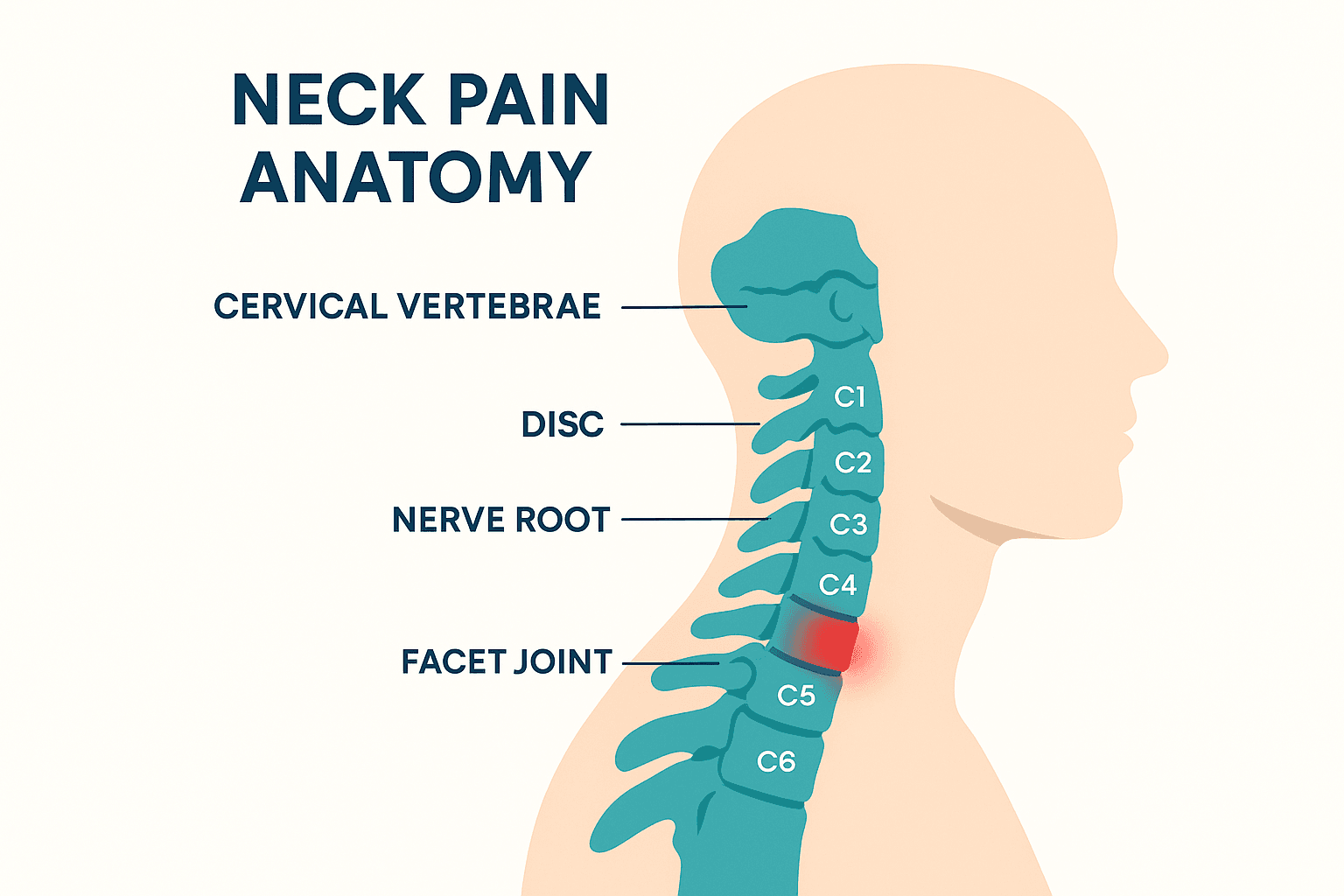
Your cervical spine is a marvel of engineering: seven small vertebrae (C1 through C7) stacked to support the weight of your head — roughly 5 kilograms — while allowing an extraordinary range of movement in almost every direction.
The top two vertebrae have specialized roles. C1 (the atlas) cradles the skull and is responsible for about a third of your forward/backward nodding motion. C2 (the axis) is the pivot on which your head rotates — accounting for approximately 60% of all cervical rotation. Every time you shake your head “no,” that’s almost entirely C2 working.
Below them, C3 through C7 share similar structure: vertebral bodies cushioned by intervertebral discs, facet joints guiding movement, and an exit point on each side for spinal nerve roots that travel down into your shoulders, arms, and hands.
Surrounding all of this is a layered system of muscles — from the deep stabilizers close to the spine (the deep neck flexors) to the larger superficial muscles like the upper trapezius, levator scapulae, sternocleidomastoid, and scalenes that move and support the head.
When any of these structures — joints, discs, nerves, or muscles — is irritated, overloaded, or injured, the result is neck pain.
What Neck Pain Feels Like
Neck pain presents differently depending on its source, but common experiences include:
- Localized ache or stiffness at the back or sides of the neck, often worse in the morning or after sustained postures
- Limited range of motion — particularly rotation (looking over your shoulder) or extension (looking up)
- Referred pain to the base of the skull, temples, forehead, or between the shoulder blades
- Arm symptoms — when nerve roots are involved, pain, tingling, or numbness may travel down the shoulder, arm, or into the fingers
- Headaches originating from the upper cervical spine (cervicogenic headache) — typically felt on one side, starting at the base of the skull and radiating forward
- Muscle spasm — involuntary tightening that can lock the neck in a guarded position
Many people find their neck pain worsens with prolonged sitting, screen work, stress, and cold environments, and eases temporarily with warmth, movement, or lying down.
Chiropractic
Chiropractic care focuses on restoring mobility and alignment to the cervical and thoracic spine through spinal manipulation and mobilization — techniques that reduce joint restriction, decrease pain, and improve the nervous system’s ability to coordinate movement.
For neck pain, chiropractic assessment evaluates the entire spinal chain: restrictions in the thoracic spine (mid-back) frequently contribute to cervical overload, and addressing these often produces rapid improvement in neck symptoms.
Your chiropractor at Wellness Place will combine spinal adjustments with soft tissue techniques, exercise guidance, and lifestyle advice, taking a whole-body view that looks beyond the site of pain to its mechanical source.
Massage Therapy (RMT)
Registered Massage Therapy directly addresses the soft tissue component of neck pain — the chronically contracted muscles, adhesions, and trigger points that physiotherapy and chiropractic cannot fully resolve alone.
Key techniques your RMT will use include:
Trigger point therapy: Sustained compression and transverse friction on taut muscle bands in the upper trapezius, sternocleidomastoid, scalenes, and levator scapulae — the muscles most implicated in neck pain and cervicogenic headache. Releasing these trigger points relieves both local neck symptoms and referred pain into the head and shoulders.
Myofascial release: Gentle, sustained stretching of the fascial system surrounding the cervical muscles restores the glide between tissue layers and reduces the mechanical tension that perpetuates stiffness.
Deep tissue work to the cervical and upper thoracic region: Loosening the broader tissue environment allows the joints and nerves to move with less restriction and irritation.
Most people with neck pain notice significant improvement in mobility and pain levels within a few massage sessions, and regular treatment helps prevent recurrence in those with demanding postural or occupational loads.
Self-Care You Can Start Today
Heat and Cold
Apply heat (a warm pack or shower) to tight muscles before activity or in the morning to ease stiffness. Use ice after exacerbating activities to reduce inflammation. Many people find alternating heat and ice particularly soothing.
The Chin Tuck
This simple exercise counteracts the forward head posture that drives most postural neck pain:
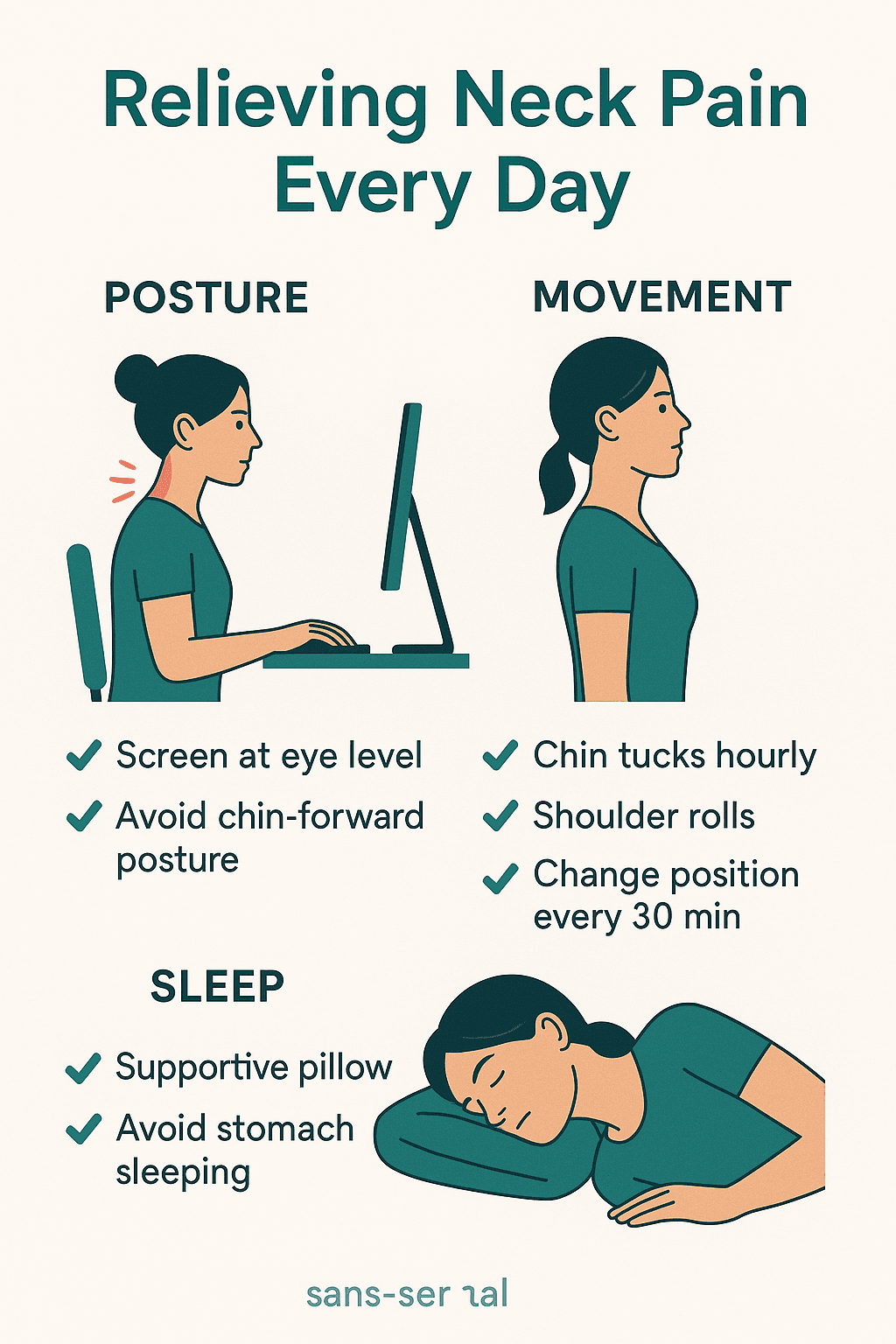
1. Sitting or standing tall, gently draw your chin straight back — as if making a “double chin”
2. You should feel a light stretch at the base of the skull and a gentle activation of the deep front neck muscles
3. Hold 5 seconds; repeat 10 times, several times per day
Neck Range of Motion
Gentle, pain-free movement through full range (rotation, flexion, extension, side bend) maintains joint health and prevents stiffening. Do these slowly, never forcing into pain.
Levator Scapulae Stretch
This releases one of the most commonly tight muscles in neck pain:
1. Drop your right ear toward your right shoulder
2. Add a slight forward tilt (looking toward your right armpit)
3. Use your right hand to gently add overpressure
4. Hold 30 seconds; repeat on both sides 2–3 times daily
Ergonomics
- Screen at eye level — not looking down
- Chair height so feet are flat and elbows at 90°
- Phone at eye level — never wedged between ear and shoulder
- Take a movement break every 45–60 minutes
Sleep Position
- A supportive pillow that keeps your neck in neutral alignment (not too high, not too flat) makes a significant difference
- Sleeping on your back or side is preferable to stomach sleeping, which rotates and loads the cervical spine for hours
Frequently Asked Questions
Is it safe to crack my own neck?
Self-manipulation — twisting your neck until it “pops” — provides momentary relief but doesn’t address the underlying cause, and done habitually it can increase joint laxity and dependency. If you feel you need frequent cracking, it’s a signal that joint mobility needs to be addressed properly by a physiotherapist or chiropractor.
Can a “pinched nerve” heal on its own?
Many cases of cervical radiculopathy (nerve root irritation) do improve with conservative treatment over weeks to months. Physiotherapy can decompress the nerve through posture correction, traction techniques, and nerve mobilization. Surgery is rarely needed and is reserved for cases with severe, progressive neurological deficit.
How long does whiplash take to heal?
The majority of whiplash injuries resolve within 3 months with early, active treatment. A subset of patients develop persistent symptoms — early physiotherapy, rather than prolonged rest, is strongly associated with better outcomes.
My neck pain keeps coming back — is this normal?
Recurrent neck pain is very common, particularly in people with demanding postural or occupational loads. It usually means the underlying contributors (weak deep stabilizers, poor ergonomics, stress-driven muscle tension) haven’t been fully addressed. A targeted rehabilitation program focused on the root cause — not just symptom management — significantly reduces recurrence.
Do I need an X-ray or MRI?
For most neck pain, imaging isn’t needed at the outset — a thorough clinical assessment by your physiotherapist or chiropractor provides the information needed to begin effective treatment. Imaging is indicated if red flag symptoms are present, if symptoms are severe and not improving, or if neurological signs suggest nerve or spinal cord involvement.
This article is for patient education purposes and does not constitute medical advice. Please consult a qualified healthcare provider for assessment and treatment of your specific condition.