
Achilles Tendinopathy: Understanding and Recovering from Heel Cord Pain
What Is Achilles Tendinopathy?
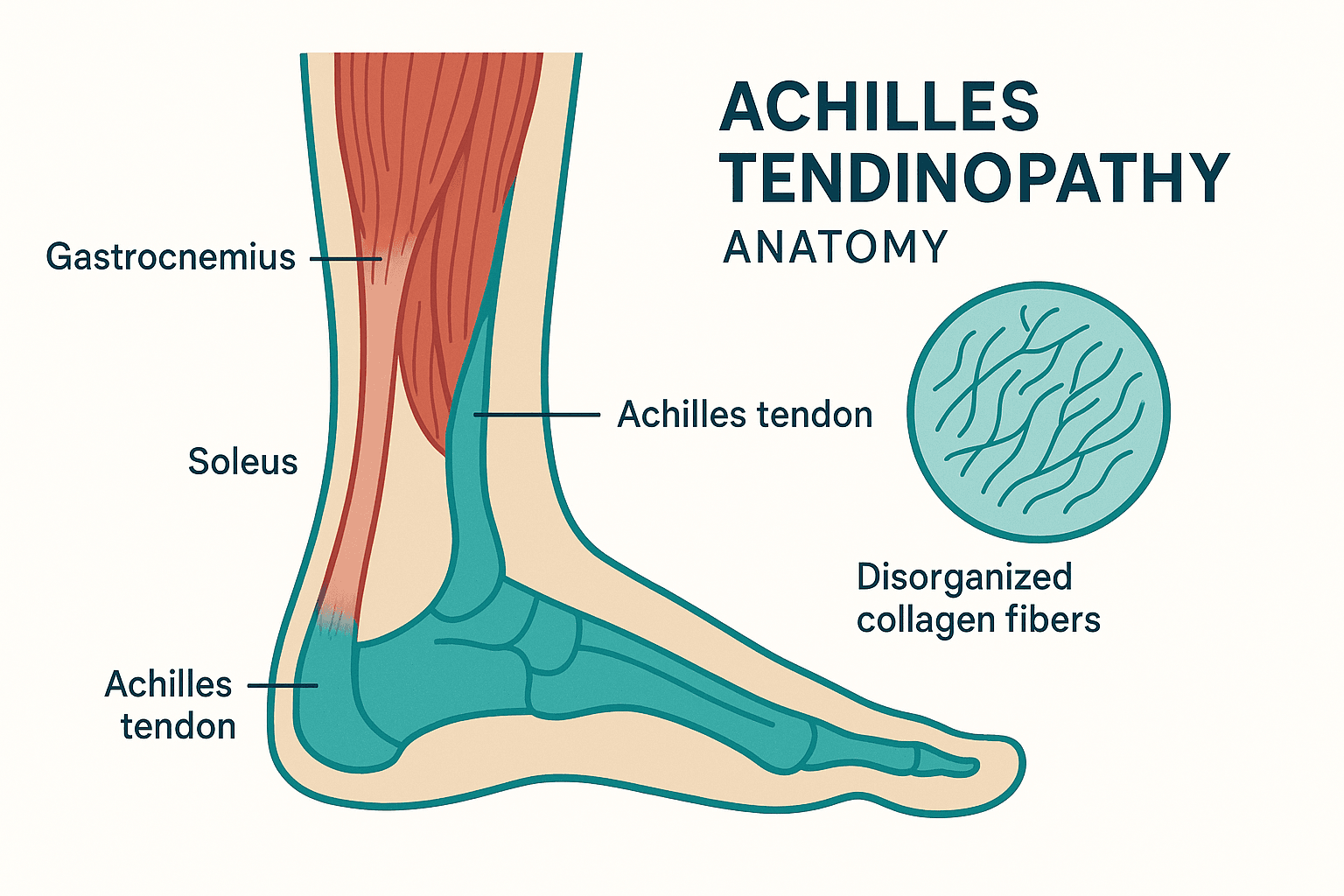
Like plantar fasciitis, Achilles tendinopathy is not primarily an inflammatory condition (despite the old name “Achilles tendinitis”). It is a degenerative condition in which the collagen fibres of the tendon break down from repetitive overload — more micro-damage accumulating than the tissue can repair. The result is disorganized, weak collagen that produces pain and reduced load tolerance.
Achilles tendinopathy most commonly affects one of two locations:
– Mid-portion tendinopathy — pain 2–6 cm above the heel insertion, in the body of the tendon. Most common, particularly in runners.
– Insertional tendinopathy — pain right at the point where the tendon attaches to the heel bone (calcaneus). More resistant to treatment and influenced by bone spurs.
Symptoms
- Morning stiffness at the back of the heel or lower calf — improves after 5–10 minutes of walking (similar to plantar fasciitis)
- Pain that warms up during exercise, then may return or worsen after cooling down
- Tenderness on palpation — pressing on the tendon reproduces pain
- Thickening of the tendon — visible or palpable swelling or nodule in the mid-portion
- Crepitus — a creaking or crackling sensation on movement
- Pain with calf raises or any explosive push-off
Self-Care Strategies
Morning Routine
Before your first step in the morning, perform calf raises (both legs, flat surface, 10–15 repetitions) to gradually load the tendon from its resting state. This significantly reduces that post-rest pain spike.
Load the Tendon — Don’t Rest It
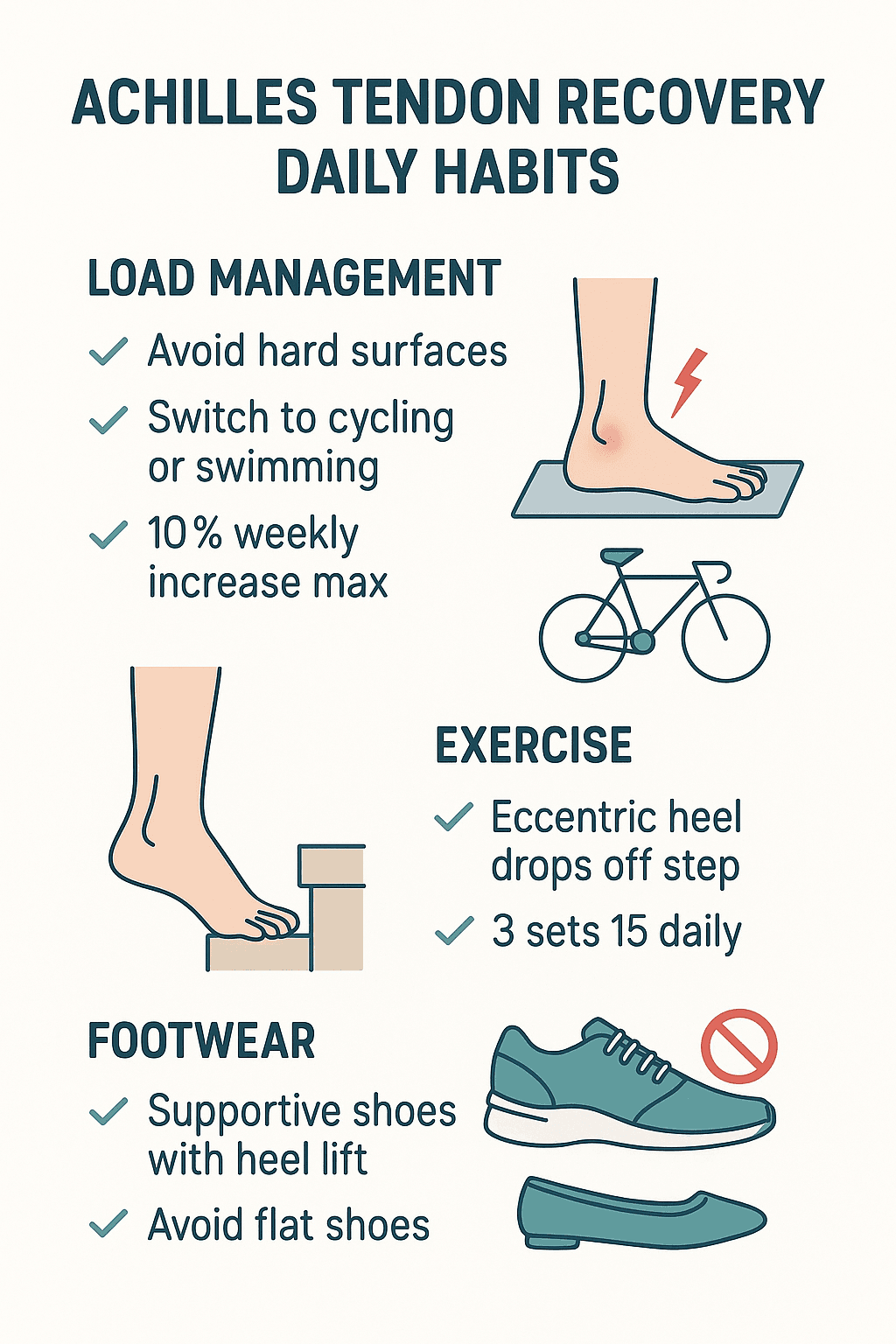
Complete rest causes the tendon to weaken further. The goal is to find a level of loading that produces at most 3–4/10 pain, and to build from there. Pain during exercise is acceptable; pain that persists more than 24 hours after activity means you’ve done too much.
Heel Raises with Correct Technique
Slow, controlled heel raises (3 seconds up, 3 seconds down) performed on flat ground, 3 sets of 15, once daily. Progress to a small step once pain is consistently below 3/10.
Appropriate Footwear
Supportive footwear with a modest heel lift reduces the demand on the Achilles. Avoid flat shoes (flip-flops, barefoot shoes) during recovery.
Frequently Asked Questions
How long does Achilles tendinopathy take to heal?
Mid-portion tendinopathy: 3–6 months of consistent loading exercise produces good results in most cases. Insertional tendinopathy tends to be more stubborn — 6–12 months is typical. Recurrence is common without maintenance loading.
Should I stop running completely?
Not necessarily. Many people can maintain running at a reduced, modified level during rehabilitation. Your physiotherapist will help you identify what level is appropriate for your current presentation.
Is surgery ever needed?
Very rarely — for true cases of chronic, treatment-resistant tendinopathy with significant tendon degeneration or large calcific deposits. Conservative care (physio + shockwave) resolves the condition in the vast majority of patients.
For patient education only. Not medical advice.