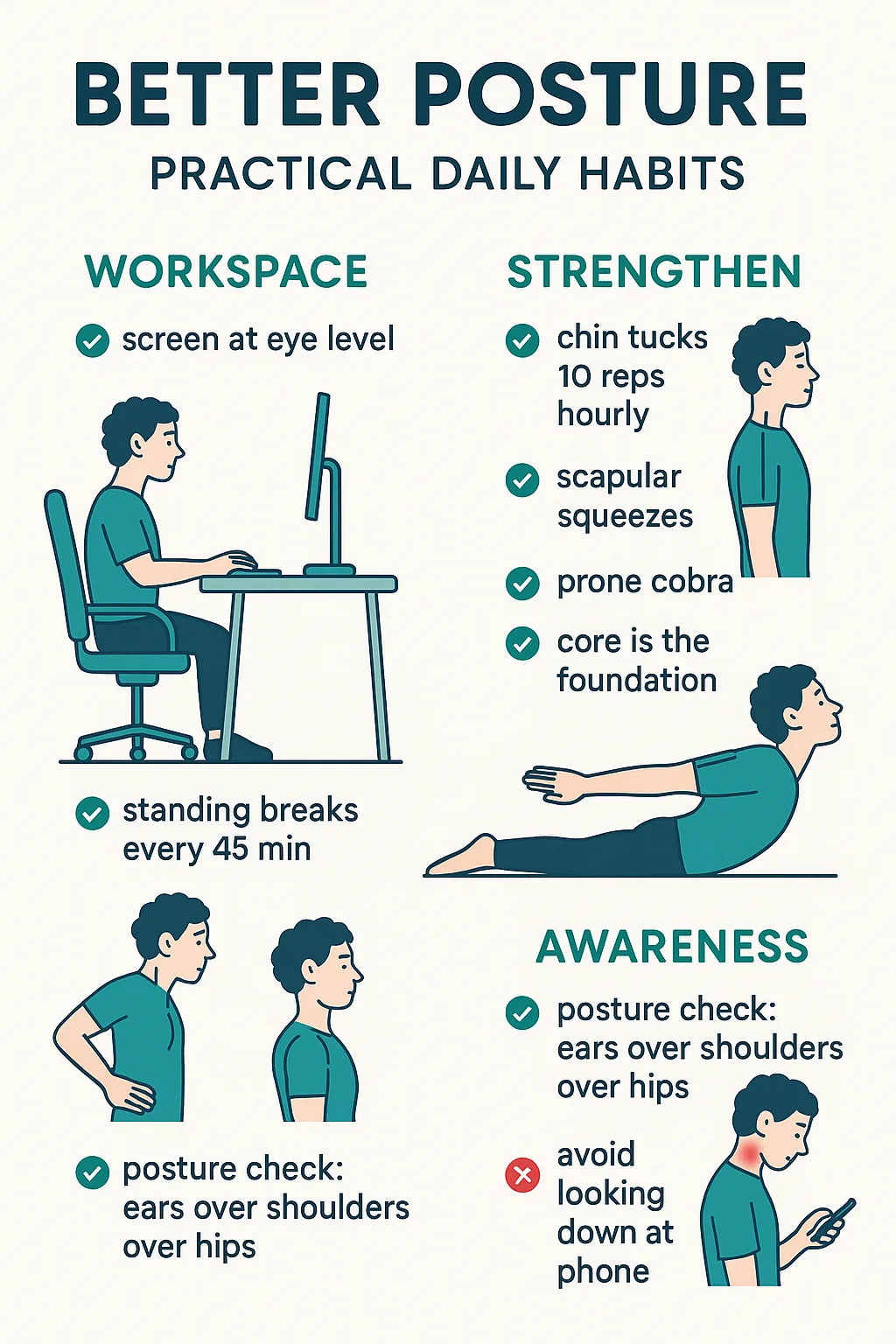
Poor Posture: Why It Matters — and What Can Actually Fix It
What “Posture” Actually Means
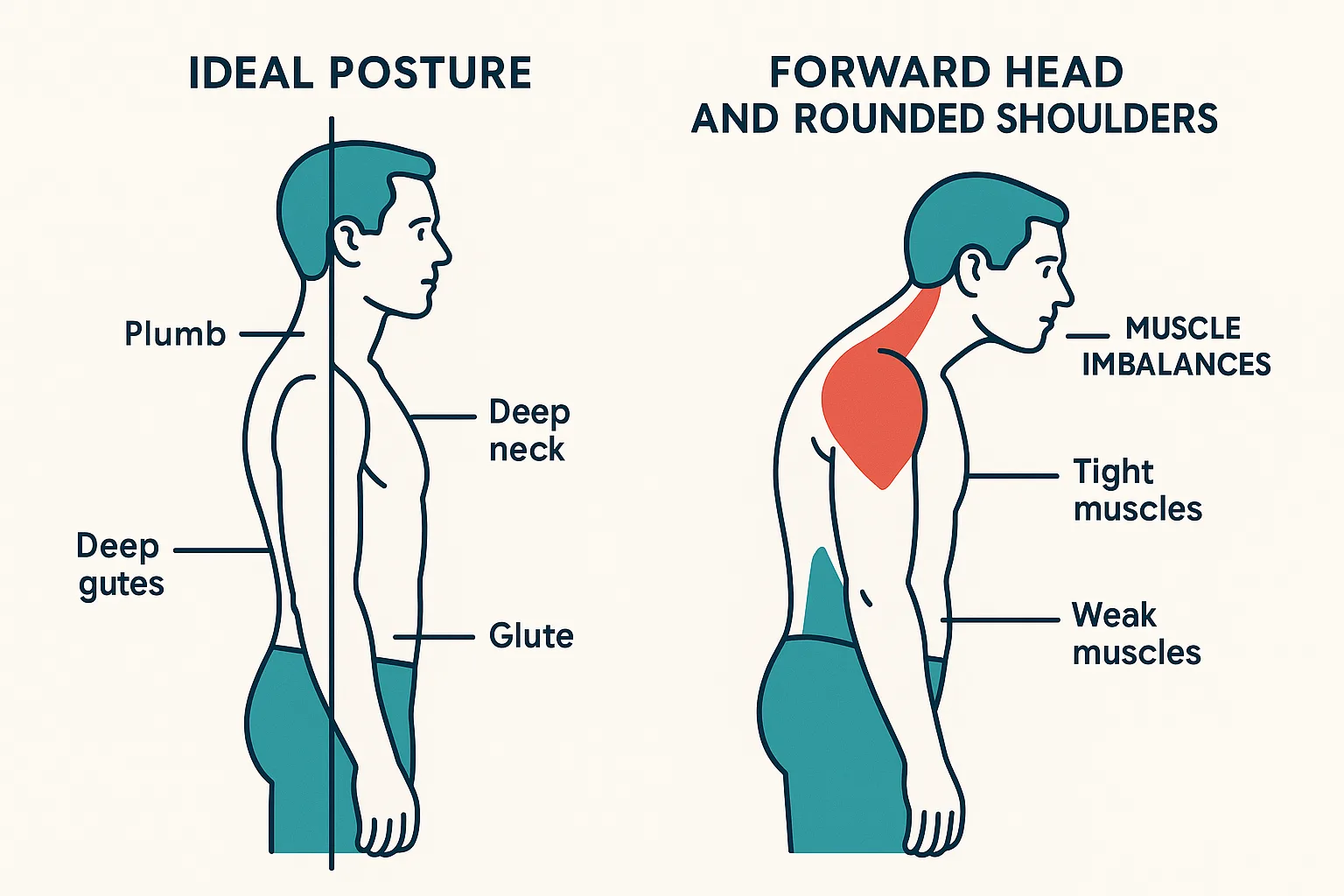
Posture is not about standing up straight and pulling your shoulders back. It is the alignment of the body’s segments relative to each other and to gravity — in static positions (sitting, standing) and during movement. Good posture is not a rigid position; it is the absence of sustained harmful loading on the joints, muscles, and neural structures.
Static posture refers to how the body is held at rest — the position of the head, spine, shoulder girdle, and pelvis during sitting and standing.
Dynamic posture refers to how the body moves — the mechanics of walking, lifting, bending, and reaching. Poor dynamic posture is often more significant clinically than poor static posture.
Ideal spinal alignment involves three natural curves:
– Cervical lordosis (inward curve of the neck)
– Thoracic kyphosis (outward curve of the mid-back)
– Lumbar lordosis (inward curve of the low back)
These curves distribute gravitational load efficiently. When they are exaggerated, reduced, or shifted, loading becomes uneven — producing tissue stress that, over time, creates pain and structural change.
Treatments at Wellness Place
Physiotherapy
Physiotherapy is the cornerstone of postural correction — because lasting postural change requires retraining the neuromuscular system, not just adjusting position:
Postural assessment: A physiotherapist will perform a comprehensive postural and movement assessment — identifying the specific muscle imbalances, movement patterns, and joint restrictions driving the postural deviation.
Targeted exercise rehabilitation:
– For upper crossed syndrome: Strengthen the deep neck flexors, lower trapezius, serratus anterior, and mid-back muscles (rhomboids); lengthen the pectorals, upper trapezius, and scalenes
– For lower crossed syndrome: Activate and strengthen the glutes, deep abdominals, and hip external rotators; lengthen the hip flexors and lumbar extensors
– Core stability: Targeted deep core training (transversus abdominis, multifidus, pelvic floor) creates the foundation for improved postural control
– Movement pattern retraining: Correcting the movement patterns that load the spine inappropriately — hip hinge mechanics, bracing technique, single-leg stability
Manual therapy: Joint mobilization for restricted thoracic and cervical segments that prevent full postural correction; soft tissue work for adaptively shortened tissues.
Dry needling: Releasing the hypertonic muscles that maintain poor postural patterns — upper trapezius, pectorals, hip flexors — to allow the corrective exercises to work.
Chiropractic
Chiropractic care specifically addresses the joint mobility restrictions that both cause and are caused by poor posture:
- Thoracic manipulation/mobilization: Restoring thoracic extension mobility is foundational to correcting rounded shoulders and forward head posture — a thoracic spine that cannot extend will not allow the head and shoulders to retract
- Cervical care: Addressing facet restriction and protective muscle splinting in the cervical spine
- Rib mobilization: Restricted ribs impair thoracic rotation and breathing mechanics, contributing to postural limitations
- Ergonomic and lifestyle guidance: Identifying and modifying the postural habits driving the patterns
Massage Therapy
Massage therapy addresses the soft tissue component of postural dysfunction — the adaptively shortened muscles and fascial restrictions that resist postural correction:
- Pectoral release: Essential for rounded shoulder correction — chronically shortened pectorals will pull the shoulders forward regardless of exercise effort
- Hip flexor work: Releasing the iliopsoas and rectus femoris creates the tissue freedom for pelvic neutral and lumbar spine restoration
- Posterior chain activation preparation: Releasing facilitated (overactive) muscles allows inhibited antagonists to engage — massage prepares the tissue for corrective exercise
- Regular therapeutic massage maintains the tissue freedom that exercise and joint work create
Frequently Asked Questions
Can posture cause headaches?
Yes — forward head posture and upper trapezius tension are among the most common causes of tension-type headaches. The sub-occipital muscles (at the base of the skull) are particularly compressed by forward head posture and refer pain into the forehead and behind the eyes. Correcting the postural pattern often eliminates or significantly reduces headache frequency.
Is poor posture reversible in adults?
Yes — but the process takes longer as structural adaptation increases over time. Significant postural improvement is achievable at any age with consistent, targeted rehabilitation. The key is addressing both the mobility restrictions (joints and soft tissue) and the motor control deficits (which muscles need to be trained to hold the corrected position).
How long does it take to correct posture?
Measurable improvement in postural alignment is typically seen within 6–12 weeks of consistent targeted exercise. Full re-education of movement habits and muscle activation patterns takes 3–6 months of consistent effort. The more entrenched the pattern, the longer the correction — which is why early treatment is better.
For patient education only. Not medical advice.