
Acupuncture for Anxiety and Stress: What the Evidence Shows
Medically reviewed by Dr. Tatsiana Vovk, ND, Licensed Naturopathic Doctor · Last reviewed September 30, 2026
A patient came into our Newmarket clinic last winter describing her anxiety as “a motor that never turns off.” She’d tried breathing apps, cut her coffee to one cup a day, and still felt wired at 11pm. She asked if acupuncture could actually do anything for that feeling, or if it was mostly relaxation theatre. Fair question. Let’s look at what the research actually says.
What Anxiety Does to the Body
Anxiety isn’t just a mental state. It runs through a system called the HPA axis — hypothalamus, pituitary gland, adrenal glands — which controls how much cortisol your body pumps out. Cortisol is useful in short bursts (it helped your ancestors outrun predators). The problem is when it stays elevated for weeks or months. Chronic stress keeps this axis dysregulated, and that shows up as poor sleep, digestive issues, muscle tension, and a nervous system stuck in high alert.
This is why anxiety treatment that only targets thoughts sometimes falls short. The body needs to come down off alert status too, not just the mind.
What the Research Shows
Acupuncture’s effect on anxiety has been studied more seriously in the last decade, and the findings are worth paying attention to — though nobody should oversell them.
Generalized Anxiety Disorder
A 2025 meta-analysis of randomized trials in Frontiers in Neurology compared real acupuncture with sham acupuncture for generalized anxiety disorder. Real acupuncture did better at easing anxiety and improving sleep and mood. The effects were modest, but they held up against a sham control, which matters in a field with plenty of weak studies. You can read it here: acupuncture vs. sham for GAD.
Acupuncture and Cortisol
Researchers have also looked at the HPA axis question: does acupuncture actually change stress hormone output, or just make people feel calmer? In a lab study on rats, electroacupuncture blocked the rise in stress hormones that chronic cold stress normally triggers. Animal work doesn’t translate directly to people, but it offers a plausible mechanism. You can find that study on PubMed: acupuncture and HPA axis regulation.
Put together, these two lines of evidence — symptom trials and mechanism studies — give a more complete picture than either alone. It’s not proof acupuncture works for everyone with anxiety. It’s evidence that something real is happening in the nervous system, not just a placebo response from lying still for 30 minutes.
How This Plays Out in Practice
In our clinic, we typically see people using acupuncture as one part of a broader anxiety management plan, alongside therapy, exercise, or medication managed by their doctor. It’s rarely a standalone fix, and we don’t present it as one. What we do see consistently is patients reporting better sleep within the first two or three sessions, and a subjective sense of their “baseline” tension dropping. One patient described it as the difference between a phone at 90% battery drain versus 40% — same phone, same apps running, but noticeably less strain.
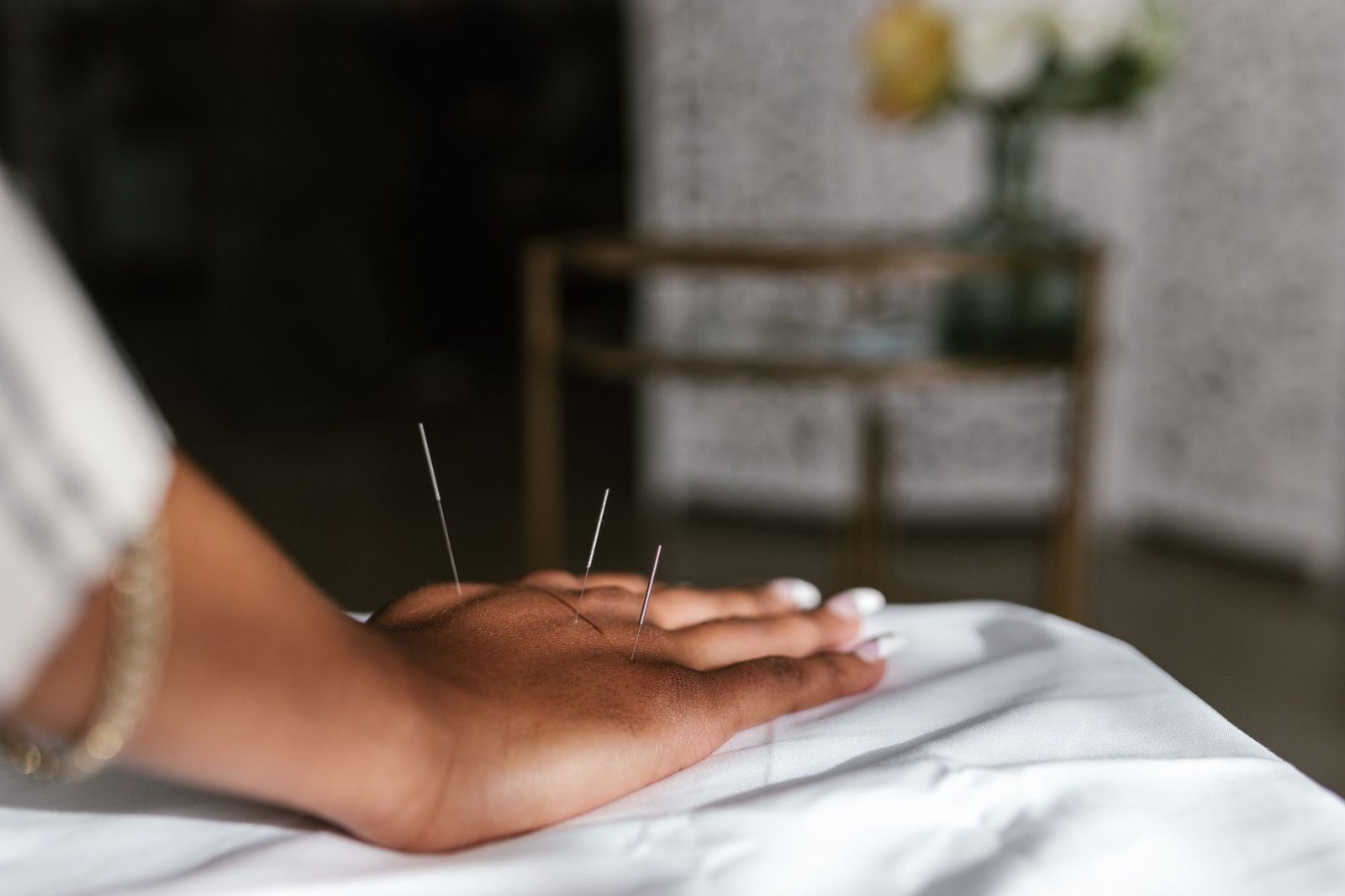
Sessions usually run 30 to 45 minutes. Needles are hair-thin, placed at specific points on the limbs, ears, and scalp associated with calming the nervous system. Most people feel heavy or drowsy afterward rather than energized. That’s normal and often a good sign the parasympathetic system — the “rest and digest” side of the nervous system — has been activated.
Who Tends to Benefit Most
From what we observe clinically, people with generalized anxiety, sleep disruption tied to stress, or physical tension (jaw clenching, shoulder tightness, stomach knots) tend to notice acupuncture’s effects fastest. People with panic disorder or more complex trauma histories often need it paired with other treatment approaches, and that’s fine. Acupuncture doesn’t need to do all the work.
Getting Started
If you’re dealing with anxiety and want to understand your options in more detail, our anxiety condition page walks through the different approaches we use, including how acupuncture fits alongside other therapies. For details on what a session actually involves, timing, cost, what to expect on your first visit, our medical acupuncture service page has that laid out plainly.
The patient I mentioned at the start came in weekly for six weeks. By week four she said the motor was still running, but quieter. That’s usually how it goes — not a switch flipping off, but the volume coming down enough that life feels manageable again. If that sounds like what you need, book a consultation and we’ll figure out if acupuncture makes sense for your situation specifically.