
Hip Pain: Causes, Treatment, and the Road to Recovery
Hip Anatomy in Brief
The hip is a ball-and-socket joint — the femoral head (ball) fitting deeply into the acetabulum (socket) of the pelvis. This deep architecture makes it inherently stable, unlike the shoulder, but it also means hip problems are often referred from the spine or, conversely, generate referred pain down the leg.
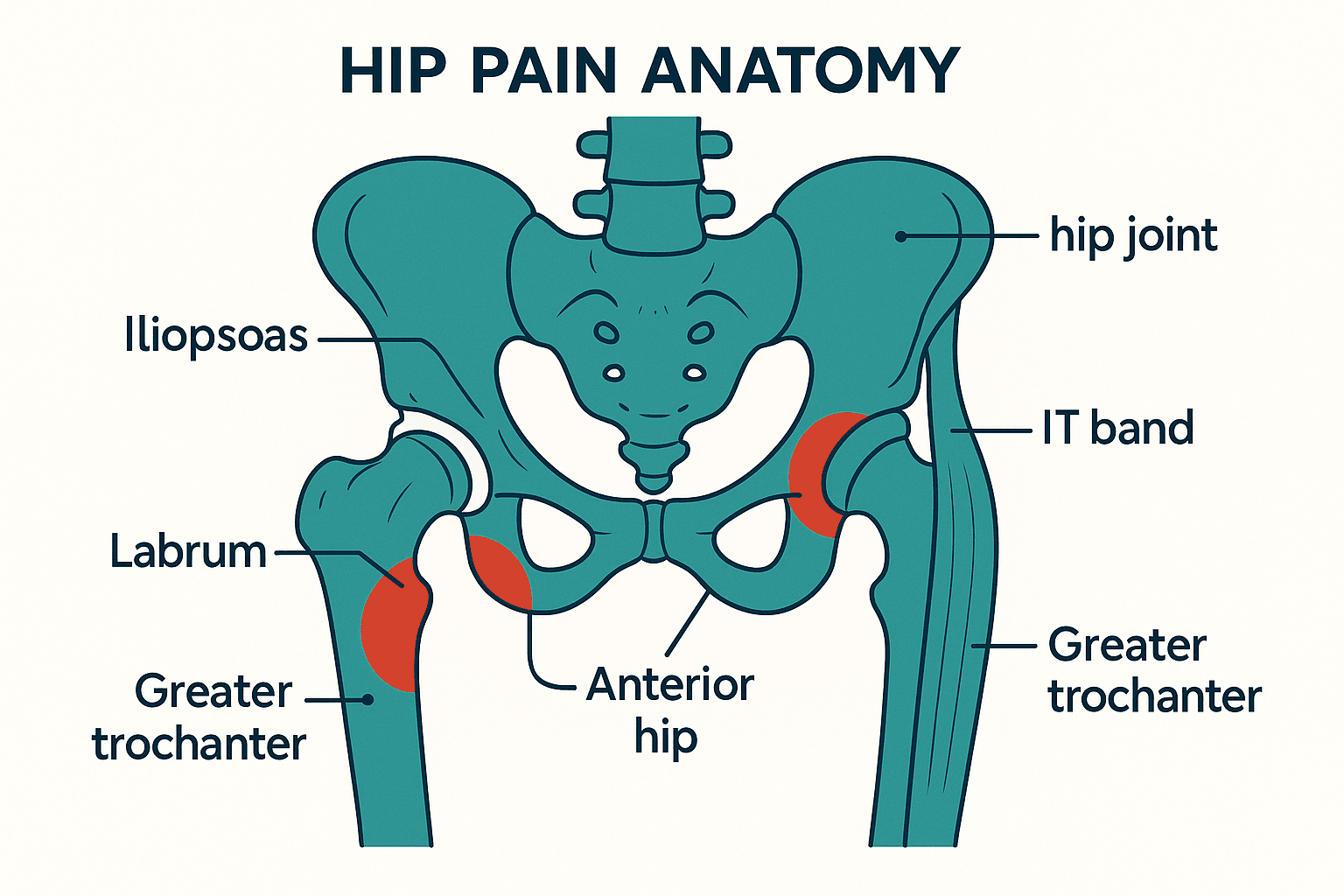
A thick layer of cartilage cushions the joint surfaces. The labrum — a ring of fibrocartilage around the socket rim — deepens the socket and seals in synovial fluid. Surrounding the joint are some of the body’s largest and most powerful muscles: the gluteals (maximus, medius, minimus), hip flexors (iliopsoas), and hip adductors.
Symptoms and What They Mean
| Location | Likely Source |
|---|---|
| Deep groin ache | Hip joint (OA, labral tear) |
| Outer hip / trochanter | GTPS / gluteal tendinopathy |
| Front of hip / groin | Hip flexor strain, labral tear |
| Buttock | Piriformis syndrome, sacroiliac joint, lumbar referral |
| Groin + knee referral | Hip OA (knee pain can be the first symptom of hip OA) |
Self-Care Strategies
Isometric Glute Press (for GTPS)
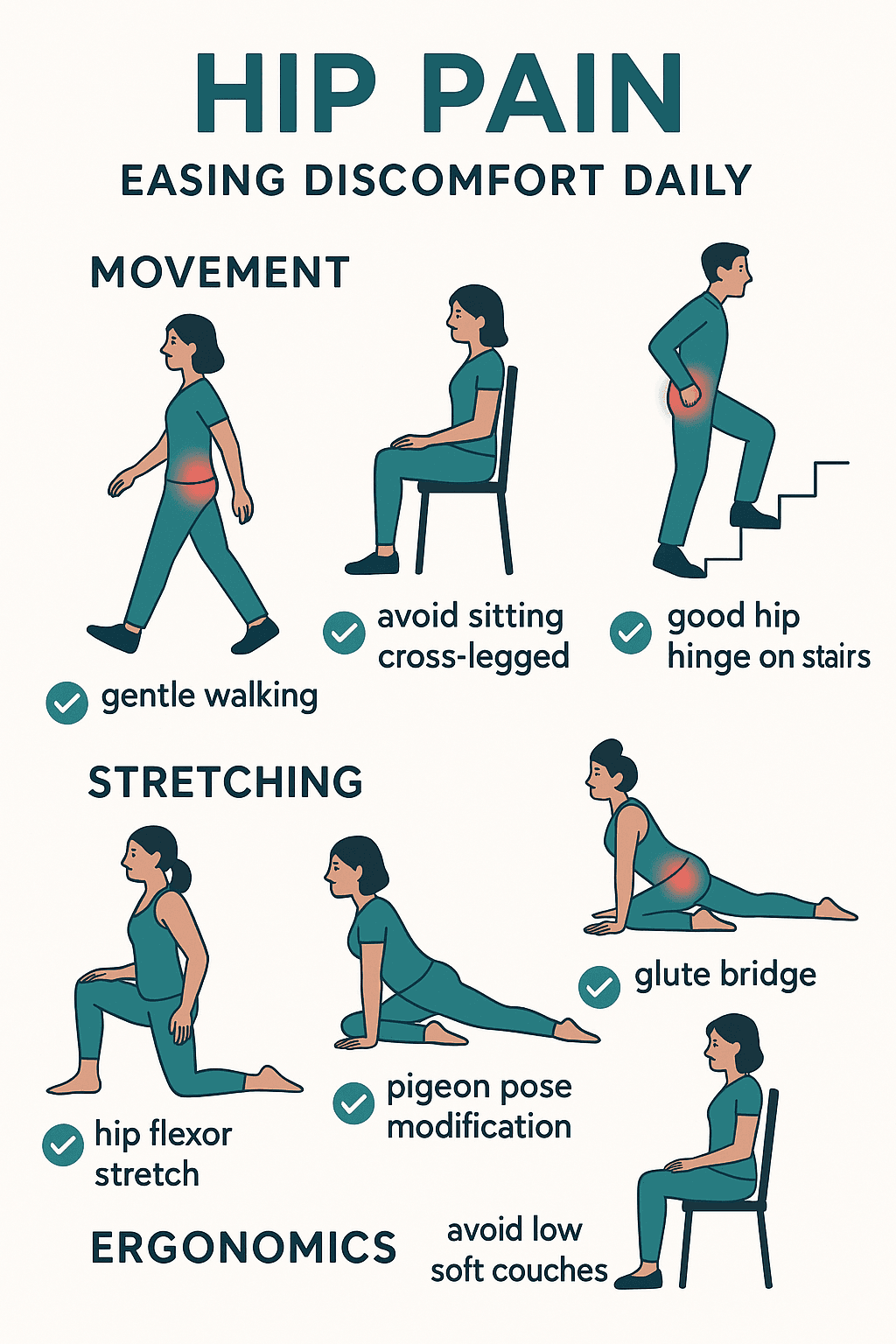
Sitting or standing, press your outer hip against a wall or fixed surface. Hold 30–45 seconds, 5 repetitions. This loads the gluteal tendons without compressing them — the first stage of GTPS rehabilitation.
Clamshells and Side-Lying Hip Abduction
As described in the knee pain article — essential hip stabilizer exercises that reduce tendon load and improve walking mechanics.
Avoid Compression Postures
For GTPS: do not cross legs, do not stand with hip hitched to one side, do not sleep with the top knee falling forward. These positions compress the gluteal tendons against the greater trochanter and flare symptoms.
Hip Flexor Stretch
Lunge position: one knee on the floor behind you, other foot forward. Tuck the pelvis slightly and shift forward until you feel a stretch in the front of the hip on the kneeling side. Hold 30–45 seconds, 3 repetitions per side.
Frequently Asked Questions
My knee hurts — could it be my hip?
Yes. Hip osteoarthritis commonly refers pain to the knee, and some patients present with knee pain as their primary complaint before a hip problem is identified. If knee treatment isn’t resolving your pain, a hip assessment is warranted.
Is hip replacement surgery inevitable with hip OA?
Not at all. Many patients with hip OA achieve excellent quality of life through conservative management — physiotherapy strengthening, load management, and weight management. Surgery becomes the right option when pain and functional limitation are severe and conservative measures have been exhausted.
For patient education only. Not medical advice.