
Shoulder Pain: A Complete Guide to Causes, Treatment, and Recovery
The Shoulder: Built for Movement, Vulnerable to Pain
The shoulder is not a single joint but a complex of four articulations working in concert. The main joint — the glenohumeral joint — connects the upper arm bone (humerus) to the shallow socket of the shoulder blade (glenoid). Unlike the hip, which has a deep cup-shaped socket, the glenohumeral joint is more like a golf ball on a tee: inherently mobile but requiring active muscle control for stability.
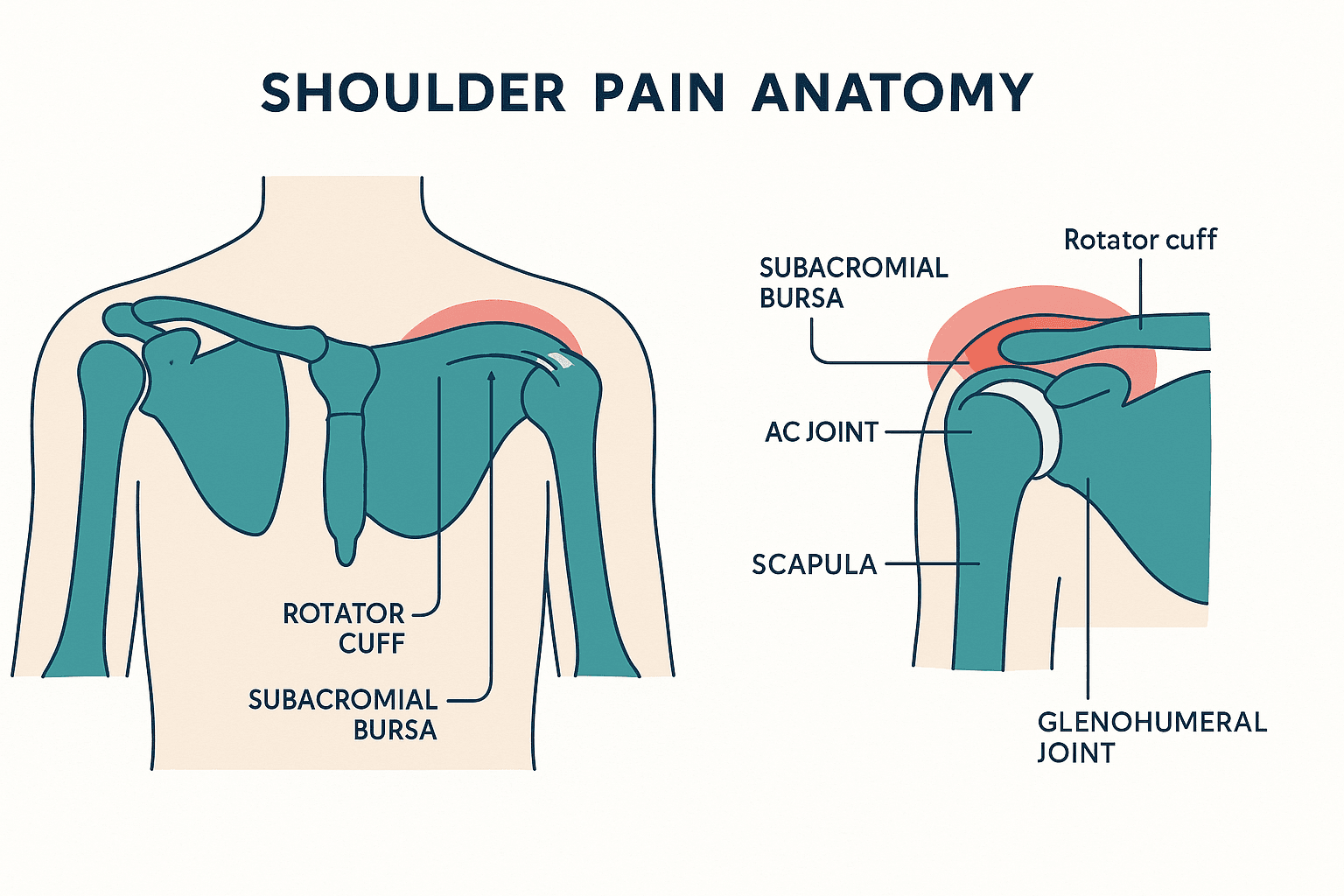
That stability is provided primarily by the rotator cuff — a group of four muscles (supraspinatus, infraspinatus, teres minor, and subscapularis) whose tendons blend into the joint capsule and hold the humeral head centred in the socket during every movement. The capsule itself is reinforced by several ligaments that restrain movement in different positions.
Above the joint, the subacromial space — a narrow channel between the top of the humerus and the bony arch of the shoulder — houses the rotator cuff tendons and a fluid-filled bursa. When this space is reduced (through posture, muscle imbalance, or injury), tendons and bursa can be compressed — the basis of shoulder impingement.
Recognizing Shoulder Pain: Common Symptoms
- Pain on the outer side of the shoulder, sometimes radiating into the upper arm
- Night pain — particularly when lying on the affected side — disrupting sleep
- A painful arc when raising the arm (pain between mid and full elevation)
- Progressive stiffness — difficulty reaching overhead, behind your back, or across your body
- Weakness with lifting, pushing, or pulling
- A clicking, catching, or grinding sensation during movement
- Muscle wasting in severe or long-standing cases
Shockwave Therapy
Shockwave therapy is a powerful treatment for tendon-related shoulder pain — particularly calcific tendinitis (calcium deposits in the rotator cuff tendon) and chronic rotator cuff tendinopathy that has not responded fully to exercise therapy alone.
Acoustic pressure waves stimulate blood flow, disrupt calcific deposits, and promote tissue remodelling at the tendon attachment. For calcific shoulder tendinitis specifically, shockwave therapy has strong evidence for pain reduction and calcium absorption, often avoiding the need for surgical intervention.
A typical course involves 3–5 weekly sessions. Shockwave pairs particularly well with physiotherapy — your physio rehabilitates the movement patterns while shockwave targets the damaged tissue directly.
Massage Therapy (RMT)
Massage therapy is particularly valuable for the soft tissue component of shoulder dysfunction — the muscular tightness, trigger points, and fascial restrictions that limit movement and perpetuate pain.
Your RMT will work on the rotator cuff muscles, deltoid, pectoralis minor, biceps, and upper trapezius — the key muscles involved in most shoulder pain presentations. Gentle muscle release techniques help regain range of motion by reducing the protective tension that builds around a painful joint, and myofascial release of the shoulder capsule and surrounding structures complements the joint work your physiotherapist performs.
Note: Massage therapy is best used as a complement to active rehabilitation — evidence suggests it is most effective when combined with exercise and manual therapy, rather than used as a sole passive treatment.
Self-Care Strategies
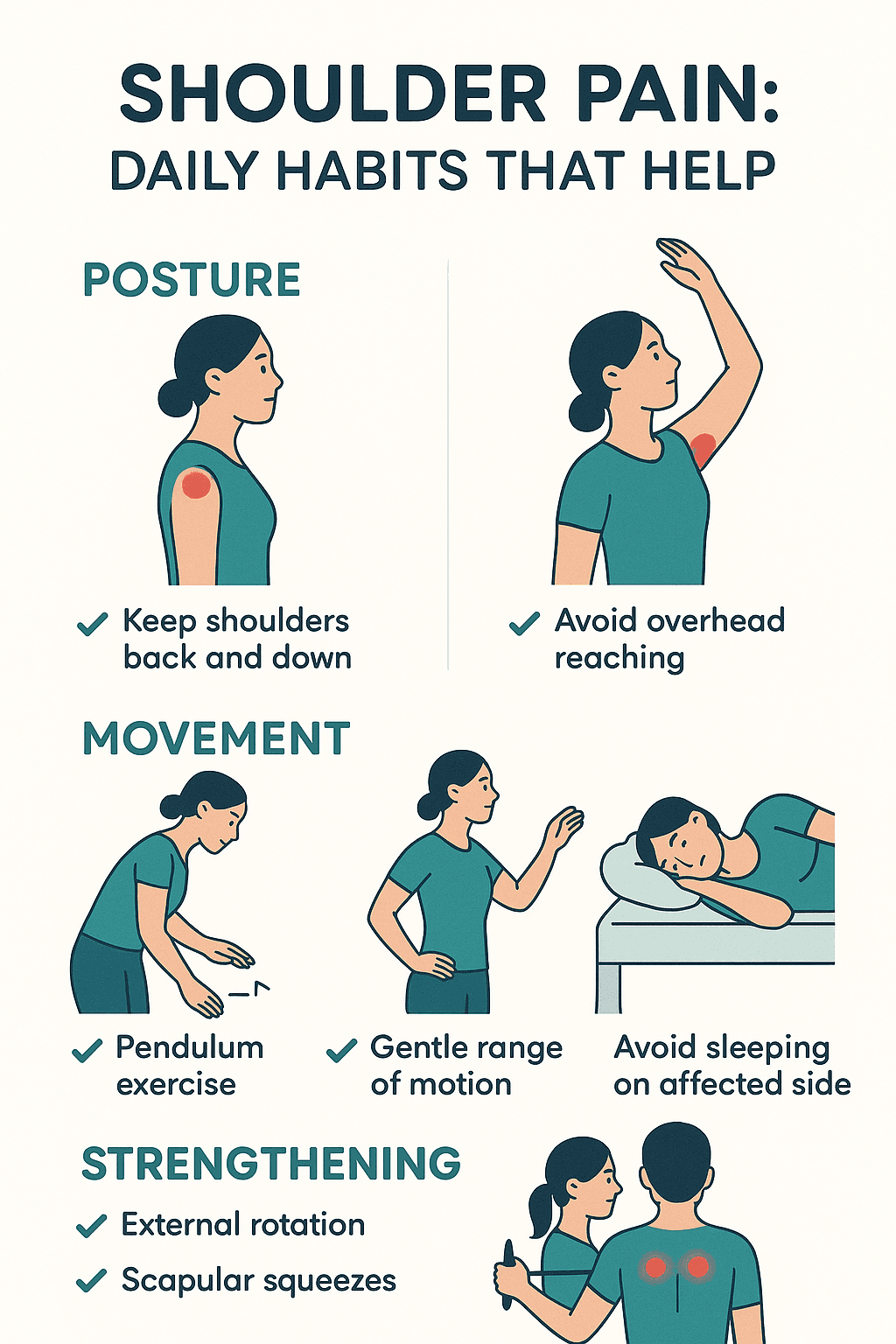
Pendulum Exercise
Lean forward with your uninvolved hand resting on a table. Let the affected arm hang freely and make small circles with it — using the momentum of your body, not your shoulder muscles. This gently distracts the joint and maintains mobility. Do 1–2 minutes several times per day.
Passive External Rotation Stretch
Lying on your back, bend the elbow of the affected arm to 90° with your upper arm at your side. Use your other hand (or a stick) to gently rotate your forearm outward, keeping the elbow tucked in. Hold 30 seconds; repeat 3 times. This is the first motion lost in frozen shoulder and the most important to maintain.
Doorway Stretch (Pectoral Stretch)
Stand in a doorway with arms bent at 90°, hands resting on the door frame. Gently lean forward until you feel a stretch across the front of both shoulders. Tight pectorals are a major contributor to impingement. Hold 30 seconds, 3 repetitions.
Activity Modification
- Avoid reaching overhead into pain until your rehab has progressed to that level
- Sleep on your back with a pillow supporting the affected arm, or on the unaffected side with a pillow between your arms
- Avoid carrying heavy bags on the affected shoulder
Frequently Asked Questions
Will my frozen shoulder go away on its own?
Yes — frozen shoulder is self-limiting and will eventually resolve without treatment, but this can take anywhere from 6 months to several years. Active physiotherapy, acupuncture, and massage significantly speed up recovery and reduce the severity of the frozen phase.
Do I need a scan before starting treatment?
Not always. Your physiotherapist can usually diagnose the likely cause of your shoulder pain from a thorough clinical assessment. Imaging (ultrasound or MRI) is recommended if a significant rotator cuff tear is suspected, if symptoms are severe and not improving, or if calcific deposits need to be confirmed before shockwave therapy.
Can I exercise with shoulder pain?
Yes, with appropriate modification. Complete rest tends to worsen frozen shoulder and delay recovery from most shoulder conditions. Your physiotherapist will guide you on which exercises are safe and beneficial at each stage of your recovery.
Is shoulder surgery usually needed?
For the majority of shoulder conditions — including frozen shoulder, impingement, and many rotator cuff tears — conservative treatment is highly effective and surgery is not required. Surgery is considered for complete rotator cuff tears with significant functional loss, or for conditions that haven’t responded to 6–12 months of appropriate conservative care.
This article is for patient education purposes and does not constitute medical advice. Please consult a qualified healthcare provider for assessment and treatment of your specific condition.