
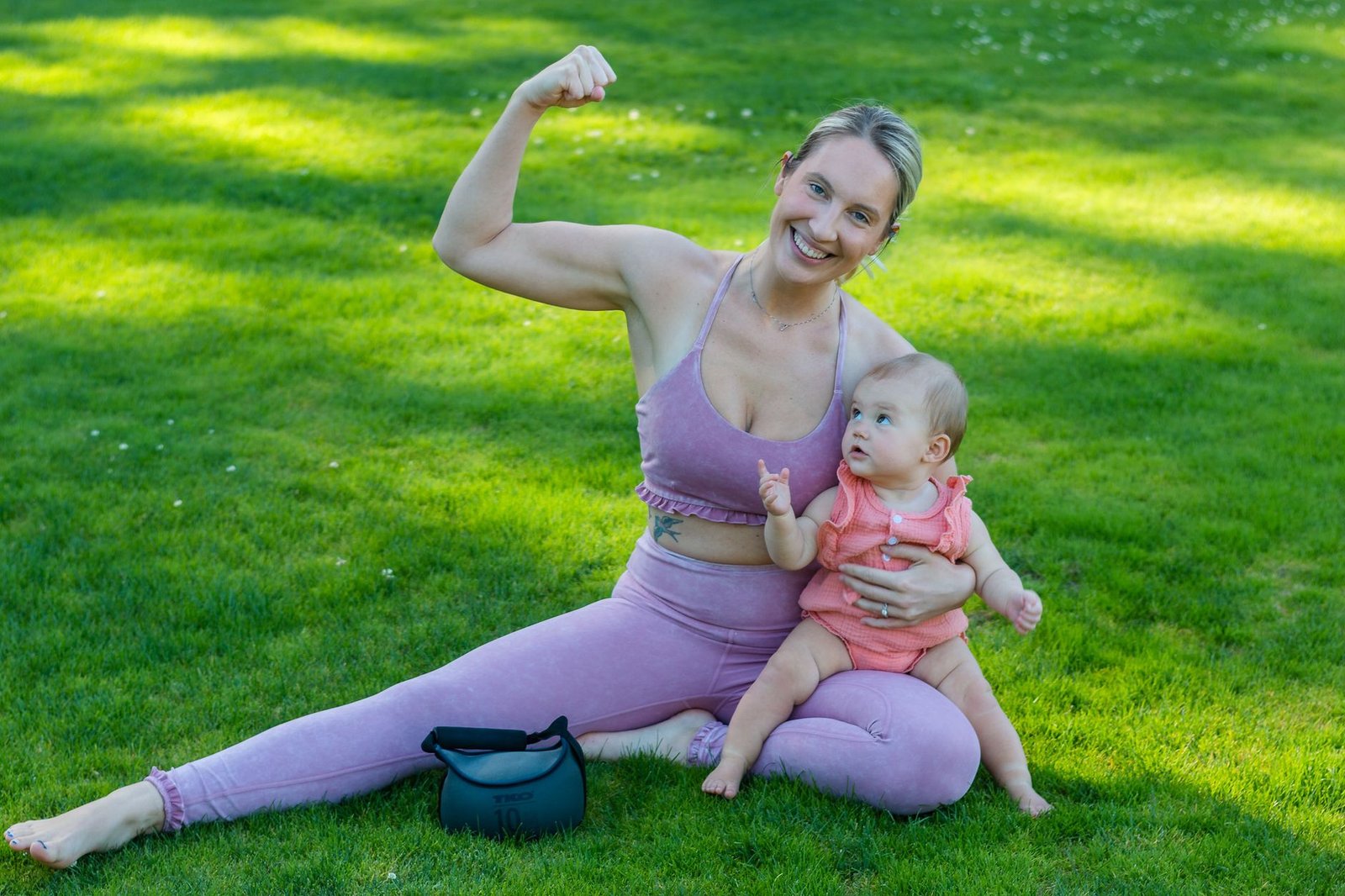
Diastasis Recti After Pregnancy: What It Is and How Physio Can Help
Your baby is a few months old. You lie on your back, lift your head to look at your belly, and a soft ridge pops up along the middle, like a little tent between your ribs and your belly button. That ridge is often the first sign of diastasis recti,, and it is very common.
This guide explains what is happening under the skin, how it is checked, what the research says about exercise, and how pelvic health physiotherapy fits in.
What Diastasis Recti Actually Is
Your “six-pack” muscle, the rectus abdominis, runs in two vertical strips down the front of your abdomen. A band of connective tissue called the linea alba holds those strips together in the middle. During pregnancy, the growing uterus stretches that band so the baby has room. The two sides drift apart.
For many people the gap narrows on its own in the weeks after birth. For others it stays wider, or the tissue in the middle stays soft and thin. That lingering separation is diastasis recti abdominis, often shortened to DRA.
It is not a tear. It is not a hernia, although the two can be confused. And it is not a sign that you did something wrong.
Signs you might notice
The classic sign is that doming or coning along the midline when you sit up from lying down or lift something heavy, like a car seat. Some people also notice a belly that still looks pregnant months later, a feeling that the core is “disconnected,” or low back discomfort. Bladder leaks or a heavy feeling in the pelvis can show up at the same time, because the deep abdominal muscles and the pelvic floor work as a team.
How the Gap Is Measured
Clinicians usually measure the inter-recti distance, which simply means the width of the gap between the two muscle strips. A physiotherapist can check it with their fingers, a measuring tool, or sometimes ultrasound, usually at a few points above and below the belly button.
Width is only part of the story. How firm the tissue feels when you gently tense your core matters too. A narrower gap that stays soft and saggy can cause more trouble than a slightly wider one that tightens well under load. That is one reason an in-person assessment is more useful than a quick self-check on social media.
What the Research Says About Exercise
Exercise is the main conservative treatment, and the evidence is growing, though it is still far from settled.
A 2021 systematic review with meta-analysis looked at seven randomized trials involving 381 postpartum women. Training the transversus abdominis, the deep corset-like muscle that wraps around your waist, reduced the gap by an average of about 0.6 cm compared with minimal intervention. The authors rated that evidence as very low quality, and concluded there was not yet strong enough science to recommend one specific exercise program. Pelvic floor training alone did not appear to shrink the gap more than minimal intervention.
A larger 2025 systematic review and meta-analysis pulled together 34 randomized trials. Abdominal exercises reduced the gap by about 6.8 mm compared with no intervention. Exercises that involve movement through a range, such as controlled curl-ups, seemed to help more than holding still, and adding electrical muscle stimulation gave an extra benefit. Again, the certainty of the evidence was rated very low, and the authors called for better-designed trials.
So the honest summary looks like this. Exercise appears to help a little, and it is low risk. Old advice to avoid every crunch forever is not well supported. Nobody has proven a single perfect routine, which is why a program built around your own body makes sense.
How Pelvic Health Physiotherapy Can Help
A pelvic floor physiotherapist in Newmarket looks at the whole system, not just the gap. A typical first visit includes a talk about your pregnancy and birth, a check of your abdominal wall, and often an assessment of how your pelvic floor and breathing coordinate.
From there, treatment usually builds in stages:
- Learning to connect breath, pelvic floor and deep abdominals, often starting on your back with gentle exhales.
- Progressing to exercises that load the abdominal wall with control, which may eventually include curl-ups done in a way your tissue can handle.
- Practising real-life tasks, like getting out of bed by rolling to your side, lifting a stroller into the trunk, or carrying a toddler on one hip.
Your physio will also watch for related issues such as leaking, pelvic heaviness or back pain, which are covered in more depth on our postpartum recovery page and in our complete pelvic floor guide.
When to get checked
It is reasonable to book an assessment if the doming is still obvious around six to eight weeks after birth, if your core feels weak during daily tasks, or if you have bladder, bowel or pelvic symptoms. Seek medical care promptly for a painful bulge that does not go back in, since that can point to a hernia. Diastasis recti can also be addressed years later.
Your Next Step
You do not need to guess your way through core recovery. Book a pelvic health physiotherapy assessment at Wellness Place in Newmarket, and leave your first visit with a clear measurement and a starting routine you can do at home during nap time.