
Sciatica: Why Your Back Pain Is Shooting Down Your Leg — and What to Do About It
Medically reviewed by Dr. Serguei Naoumov, DC, Licensed Chiropractor · Last reviewed May 26, 2026
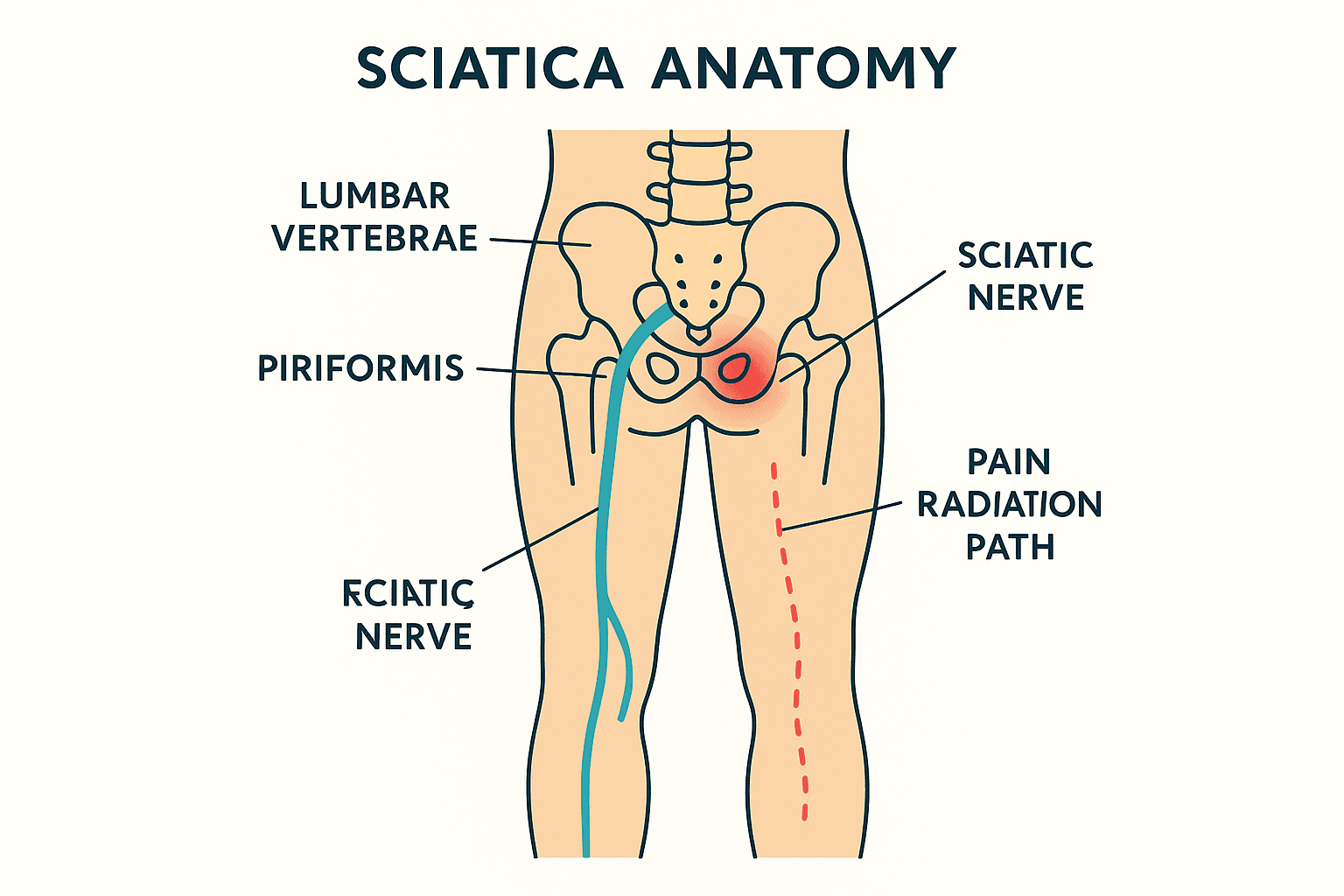
What Is the Sciatic Nerve?
The sciatic nerve is the longest and widest nerve in the human body. It forms from the L4, L5, S1, S2, and S3 nerve roots exiting the lumbar spine and sacrum, bundles together in the pelvis, passes through the greater sciatic foramen beneath (or occasionally through) the piriformis muscle, and travels down the back of the thigh — where it divides into the tibial and common peroneal nerves to serve the lower leg and foot.
Sciatica is not a diagnosis in itself but a symptom — pain along the distribution of the sciatic nerve — that can arise from compression or irritation at any point along its path.
Symptoms: How Sciatica Feels
The hallmark is unilateral (one-sided) pain that radiates from the lower back or buttock down the leg, following a predictable path depending on which nerve root is affected:
| Nerve Root | Pain Pattern | Sensory Loss | Weakness |
|---|---|---|---|
| L4 | Outer thigh → inner shin | Inner lower leg | Knee extension (quad) |
| L5 | Outer thigh → top of foot | Top of foot / big toe | Big toe / ankle extension |
| S1 | Back of thigh → outer foot | Outer foot / little toe | Plantarflexion / calf |
Other common features:
– Pain worsened by sitting, coughing, sneezing, or straining
– Pain eased by walking or lying flat in some cases
– Pins and needles or numbness in the leg or foot
– Muscle weakness in the leg (significant weakness requires urgent assessment)
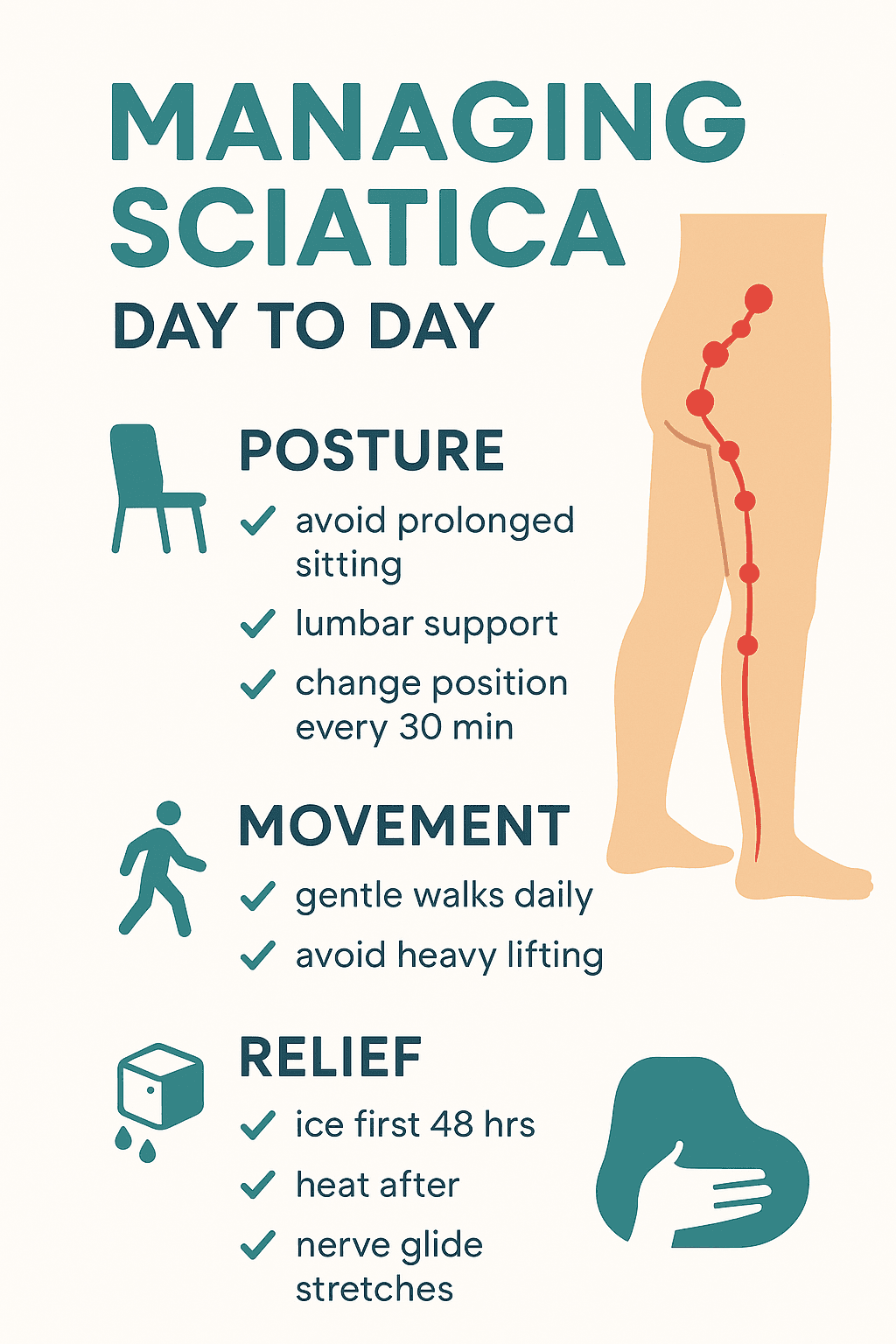
Self-Care Strategies
Nerve Flossing (Neural Mobilization)
Sit upright in a chair. Straighten the affected leg and flex your foot (toes toward you) — you’ll feel the sciatic nerve tension. Then simultaneously lower your head and bend your knee. Perform this rhythmically — 10 repetitions, 3 times per day. This “flosses” the nerve through its surrounding tissue. Stop if it significantly worsens your leg pain.
Piriformis Stretch
Lying on your back, cross the affected ankle over the opposite knee. Gently pull the opposite thigh toward your chest until you feel a deep buttock stretch. Hold 30–45 seconds. Relieves piriformis compression of the nerve.
Supported Walking
Walking — short, frequent bouts — is one of the best things for sciatica. It gently loads the spine, circulates disc nutrition, and prevents the deconditioning that prolonged rest causes.
Ice / Heat
Ice (15–20 min) for acute flares with significant inflammation. Heat for muscle spasm and chronic sciatic ache.
Frequently Asked Questions
How long does sciatica last?
Most episodes of acute disc-related sciatica improve significantly within 6–12 weeks with conservative treatment. Nerve pain can linger as an ache or tingling for longer, but the disabling, shooting pain typically resolves. Chronic sciatica (more than 12 weeks) requires more structured rehabilitation.
Do I need surgery?
Surgery is needed in a minority of cases — primarily when there is significant, progressive neurological deficit (worsening weakness), cauda equina syndrome, or when conservative treatment has been consistently applied for 6–12 weeks without meaningful improvement. The vast majority of disc herniations causing sciatica resolve without surgical intervention.
Can sciatica come back?
Yes — the underlying vulnerability (disc degeneration, core muscle weakness, movement patterns) remains unless addressed. People who complete their rehabilitation and maintain core stability, good posture habits, and an active lifestyle have significantly lower recurrence rates.
For patient education only. Not medical advice.